Medieval India Class 06
A BRIEF OVERVIEW OF THE PREVIOUS CLASS, STRATEGY, AND Q&A DISCUSSION (05:06 PM)
AURANGZEB (1658-1707) (05:39 PM)
- Aurangzeb took the title of Alamgir (Conquerer of the world). He is infamous because of his religious intolerance. For example- the Reimposition of Jaziya, and the destruction of temples, which was a significant departure from the policies adopted by Akbar.
- He was ambitious and wanted to conquer the Deccan Area. His Deccan Policy can be divided into three phases
- a) From 1658 to 1668- He wanted to consolidate his southern border and even made attempts to secure the help of Deccan Sultans against Marathas.
- b) From 1668 to 1684- There was a shift in policy, Aurangzeb's attempts to contain Marathas were not successful. Golconda tried to forge an alliance with Shivaji Maharaj
- c) From 1684 to 1687- He followed the policy of outright annexation and by 1687, Bijapur and Golconda were annexed, however, the conflicts with Marathas continued and he spent the last 20 years of his life in Deccan only.
MUGHAL ADMINISTRATION (05:48 PM)
CENTRAL ADMINISTRATION
- The Emperor was the supreme head of administration and controlled all military and Judicial powers
- Wazir- Wazirs of Babur and Humayun enjoyed great power, however Akbar in his determination to curb the power of Wazir took away the financial power of Wazir. He created a post called Diwan-e-Kul, responsible for revenue and finances. He prepared a report about state finance and presented it to the emperor on a daily basis.
- Mir Bakshi- He looked after matters pertaining to military administration. The orders of appointment of Mansabdar and their salary was endorsed and passed by him. The new entrants seeking services were presented to the emperor by Mir Bakshi.
- Sadr-e-Sudr- His chief duty was to protect Islamic laws and distribute allowances, to religious persons and institutions. Restrictions were placed on the authority of Sadr for awarding free grants by Akbar.
- Mir Saman- He was an officer-in-charge of royal Karkhanas thus all kinds of purchases and storage were done by him.
PROVINCIAL ADMINISTRATION (05:59 PM)
- During the time of Akbar, the empire was divided into 12 provinces called Subas. Later the number of Subas became 20.
- Suba was kept under Subedar i.e. Provincial governor, he was responsible for maintaining law and order, encouraging agriculture, trade & commerce.
- Diwan was head of the revenue department at the Suba level. He was appointed by the Emperor. Through his office, advanced loans called Taqavi were given to peasants
- Bakshi played the role of Mir Bakshi at the provincial level, he was responsible for checking and inspecting the horses and soldiers maintained by Mansabdars in the Suba. Often his office was combined with Waqainaqar, in this capacity his duty was to inform the center about the happenings of Suba.
- Sadr was a representative of Sadr-e-Sudr, he also looked after the work of local judges called Qazis.
- Darogai-i-Dak was responsible for maintaining communication channels with the center. Postal runners Merwars were used.
LOCAL ADMINISTRATION (06:10 PM)
- Subas were divided into Sarkars, and Sarkars were divided into Parganas.
- And one Pargana comprised of many villages.
-
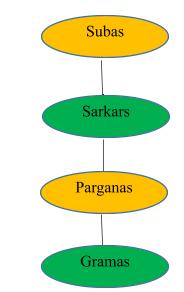
- At the level of Sarkar, two important functionaries, Fauzdar and Amalguzar/ Amil functioned. Fauzdar was responsible for Law & Order and Amil was a revenue collector. Amil maintained all accounts and sent daily receipts and expenditure reports to the provincial Diwan.
- At the level of Pargana, Siqdar was the executive officer, who assisted Amil in revenue collection.
- At the level of Pargana, Quanungo kept all records of the land.
- Kotwals were appointed mainly in towns to maintain law and order.
- At the village level, Muqaddam was the village headman and Patwari maintained land records
- The services of Zamindars were utilized for the maintenance of Law and Order as well as Revenue collection.
- Forts were raised under the officer called Qiladar.
- The port administration was independent of provincial authority. The Governor of the port was called Mutasaddi who was directly appointed by the emperor.
MANSABDARI SYSTEM (06:34 PM)
- The Mansabdari system evolved during Akbar and became the basis of civil and Military administration under the Mughals. The word Mansab means a position or a rank. The Mansab awarded to an individual fixed both his status in the official hierarchy as well as his salary. It also fixed the no. of armed retainers, Mansab was to maintain.
- Initially, single no. represented the rank but later came to be denoted by two numbers, Zat and Sawar. Zat denoted the personal rank of an officer and Sawar indicated the size of the contingent maintained by Mansabdar.
- Based on these two numbers Mansabdars were placed in three categories
- a) Zat= Sawar: (7000, 7000)
- b) Zat> sawar> 1/2 of Zat (7000, 4000)
- c) Zat> sawar< 1/2 Zat (7000, 3000)
- Thus Zat was always higher or equal to Sawar, even if Sawar was higher, the official hierarchy was decided by Zat's rank.
- Jehangir introduced a new provision in the Sawar rank, a part of the Sawar rank was termed Du-Aspa or Si-Aspa. In the case of selected Mansabdars, for Du-Aspa and Si-Aspa, Mansabdars were supposed to maintain twice or thrice the number of armed contingents and were compensated for it.
- Shahjahan continued with these changes and introduced a monthly scale system, to compensate for the gap between Jama (Estimated income) and Hasil (Actual realization). Hasil always fell short of Jama
- If a jagir yielded only half of the Jama, it was called Shash Maha and if only one-fourth, it was called Sih Maha. Based on Sash Maha and Sih Maha, Mansabdar's salary was fixed
- Aurangzeb continued with all the changes. He created an additional rank called Mashrut. It was a conditional and temporary rank that increased Sawar's rank for a brief period.
JAGIRDARI SYSTEM (06:59 PM)
- Under the Mughals, the areas assigned were called Jagir land, and its holder Jagirdar.
- The Jagirdari system was an integral part of the Mansabdari system. The salary of Mansabdars was paid either in cash or through the assignment of a Jagir, the latter being the preferable mode.
- A piece of land where revenue was directly collected by the center was called Khalisa land. These land assignments were neither permanent nor hereditary.
- In the case of recorded Jama was in excess of salary claim, Jagirdar was required to deposit the balance to central treasury and vice versa.
- Watan jagirs were assigned to Zamindars in their local dominion. Watan Jagirs were hereditary and non-transferable. When a Zamindar was made a Mansabdar, he was given Tankha Jagir, apart from his watan jagir at another place. If the salary of his rank was more than his income from Watan Jagir.
- Altmagha Jagir- This was given to Muslim nobles in their family town or place of birth.
- During the reign of Aurangzeb, there was great pressure on Khalisa land as the number of claimants for Jagir increased with the increase in no. of Mansabdars. This led to the Jagirdari crisis and became one of the important reasons for the downfall of the Mughal Empire.
LAND REVENUE ADMINISTRATION (07:23 PM)
- In Land revenue system of Akbar was called Zabti or Bandobast System. It was based on the Sher Shah Land revenue system with certain modifications. It was further improved by Raja Todar Mal who introduced the Dahsala system in 1580 AD. Under this system, the revenue was fixed on the average yield of the last 10 years. Land revenue was fixed at 1/3rd of the produce.
- Land was classified into 4 categories-
- Polaj - cultivated every year
- Parauti/ Parati- cultivated once in two years
- Chachar- cultivated once in 3-4 years
- Banjar- once in 5 or more years
- Land revenue was decided based on quality. Officials called Karoris were appointed and were responsible for the collection of revenue and checking the facts and figures issued by Quanaungo.
- In some parts of the empire, the Ghalla Bakshi system was used which can be divided into three systems i.e. Batai, Khatt Batai, and Lang Battai.
- In Battai method the harvested crop was stacked in heaps and the government officers took one heap according to state demand.
- In Khatt Battai, unripe crops in the field were divided and marked to show the government's share.
- In the Lang Battai method, the chaff from the grain was removed and then Battai occurred.
- Growth of trade occurred all across the empire, Seth and Bohra were long-distance traders, and Banik were local traders. Banjaras carried bulk goods and travelled long distances and they were caravan traders.
REGIONAL KINGDOMS- AFTER THE DISINTEGRATION OF DELHI SULTANATE (07:35 PM)
JAUNPUR
- Sharqi Dynasty- Mubarak Shah became the first ruler.
- Jaunpur emerged as center of great learning + Sharqi style of Architecture (Indo-Islamic architecture)
-

- It was captured by Bahlol Lodi.
KASHMIR
- 7th century- Karkota Dynasty, founded by Duralbh Vardhan.
- Rajtarangini is a major source to know about Kashmir
- Lalitaditya, from the Karkota dynasty, is an important ruler who expanded the territory. He constructed the Martand Sun temple.
- Utpala dynasty- Avanti-Varman was an important ruler.
- Lohara dynasty- Didda was an important Queen
- Sikander Shah- Ruled till 1413 and destroyed a lot of temples, imposed jizya. He took the title of "But-Shikan".
- Zain-ul-Abideen- (1420-1470)- He abolished Jizya. He invested in the textile industry, the carpet industry, etc.
MALWA
- Ala Khan ascended the throne
- Baz Bahadur was defeated by Akbar. He is a contemporary of Akbar. He was associated with Queen Roopmati.
GUJARAT
- Mahmud Begarha was the famous ruler
- He fought in battle with the Portuguese.
- Conquered by Akbar in 1572
BENGAL
- Haji Iliyas & Alauddin Hasan Shah were the famous rulers
ASSAM
- Ahoms migrated from the nearby region.
- Three cultures emerged together
- Sukhaphaa established the kingdom
- Shankara Deva was the Vaishnavite reformer
THE CLASS OF MEDIEVAL INDIA STANDS CONCLUDED.